
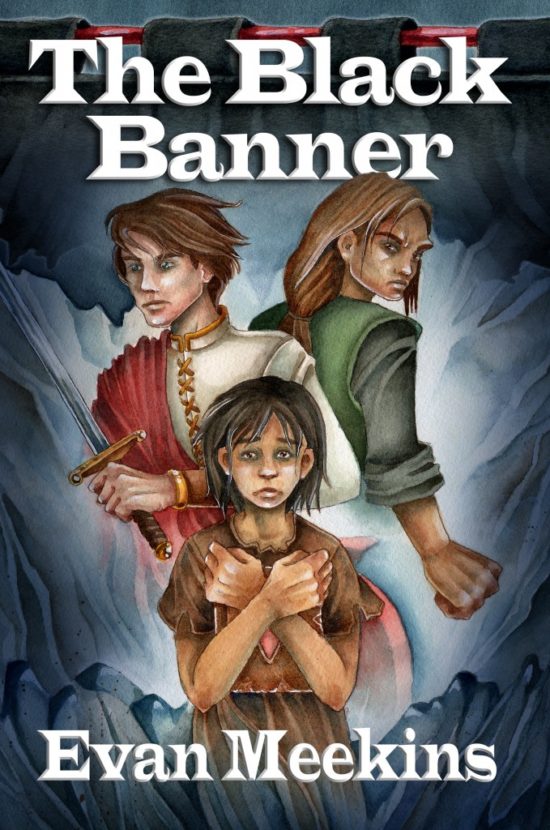
The Black Banner
| Buy this title now from these booksellers or a store near you. |
||||
| Amazon | Barnes & Noble | Books a Million | Powell’s Books | Indie Bound |
SALES HANDLE
“The Black Banner” is a Tolkienesque young adult fantasy of war and rebellion. It takes place on the continent of Verden, home to Humans, Elves, and Dwarves, and the Roegan rebels who wish to be free.
DESCRIPTION
Milcas, a young Roegan slave boy, dreams of a day when his race will be free. After finding a mysterious key, Milcas sets forth a series of events that spark a rebellion. The politics in Verden change as Humans, Elves, and Dwarves decide on whether they will confront the Roegan threat or try to make peace with the rebels. Leaders will be tested, alliances will be made and broken, and the fate of an entire continent will rest in the hands of a young Prince who is pure in heart but lives in the wide shadow of his father. Will anyone be able to stop the warpath of the Roegan rebellion, or will their Black Banner fly high over all of Verden?
KEY SELLING POINTS
• This is a young adult fantasy book with mass market appeal
• First of a planned series
• Similar in plot to Tolkien’s Lord of the Rings
AUTHOR BIO
Evan Meekins is a freshman at James Madison University and majoring in Physics. “The Black Banner” is his first manuscript in what promises to be a series in fantasy fiction for young adults. He is from Virginia Beach.
AUDIENCE
• Young adults
• Fantasy readers
• Adults who enjoy LOTR type fantasy
Distributor: Ingram Publisher Services
Pub Date: 04/01/2013
Price: $17.95 USD / $18.95 CAD
EAN: 978-1-938467-26-4
Trim: 6 x 9
Format: Trade Paper
Pages:300
EXCERPT
Chapter 1
It was another day in the mines of Fargranther City, where the sound of pickaxes chipping away at hard rock never stopped echoing throughout the cave in which it was seated. The constant clatter was not what caused Milcas to awaken, though. The boy had grown used to the noise, to the smell, to everything. But no Roegan can sleep through the savage barking of the guard dogs on morning patrol; much less survive the consequences that followed sleeping in.
So, Milcas rose from his bed of dirt and straw at the sound of the hounds. Just another day in Fargranther.
Milcas was twelve Roegan years old and lived with his mother and four siblings in a plain red clay hut in the heart of where the Roegans were forced to reside. The air reeked of rats, sweat, and rot. Being a major Dwarven city, Fargranther was underneath the surface of a mountain, and being so close to precious metals, their main source of income was through mining.
The inside of the cavern was almost entirely illuminated by thousands of torches that burned throughout the day and even into the cold night, save for the dark corridors where the Roegans lived. The inner walls of the mountain were the same orange-red material that made up Milcas’s house, and in places, the cavern ceiling could be as high as a castle. Milcas would not know that, though, because he had worked and lived in the mines for as long as he could remember. Every Roegan did.
It’s said that the Roegans were once a free race, but eventually they were cast down from society and labeled as lesser beings and slaves. The legend of how this occurred varies, but it is generally accepted that the Humans, Dwarves, and Elves united to overpower the Roegan people and claim them as property. Whether this act was out of fear, hatred, or greed depends solely on whom you ask. It occurred about five hundred years ago, so firsthand accounts were all too often distorted into nothing more than fairytales. Such is history, and none of the Roegans in Frothgarr had the education, funds, resources, nor the time to find out the truth. The Dwarves made sure of that.
The history of his people interested Milcas, but it was often considered a rebellious act in the Dwarven kingdom of Frothgarr to speak of the times before the war or the enslavement of the Roegan people. Thus, many of the Roegans in Frothgarr simply focused on the now instead of the past. Their only concerns were that they were able to earn enough rations to feed their family, to stay alive in the treacherous mines, and to avoid being blacklisted or beaten by their Dwarven overlords.
Milcas once knew a man who had been blacklisted. He was twice the age of Milcas, in his mid-twenties, and had broad shoulders and enough strength to move earth like no other Roegan. He worked harder than any other Roegan, and always seemed to give others a sort of hope. A hope for what, though, Milcas did not know.
That man was unusual in one way, though, in that he prayed. Any Roegan is allowed to pray, but none are terribly concerned with any of the gods, for they all thought that their predicaments were inescapable and that nobody, neither man nor god, would be able to alleviate their seemingly eternal burden. Well, at least none of the sanctioned gods. This man, obedient and non-rebellious, prayed to the only god that the Dwarves had not recognized and therefore banned. He prayed to Grothak, the god of dissent.
The Dwarves, even though they despised Grothak, allowed the man to pray to him, for they did not want to risk losing their most profitable laborer who, by himself, would rake in hundreds of pounds of precious metals a day. He could have taken credit for much more, too, because he often gave out pounds of metals that he had mined to his fellow Roegans, so as to earn them a few more rations.
One day, though, the Dwarven guards, stumpy yet muscular in stature with overgrown beards knotted in various styles and braids, seized him and questioned him. “Why do you worship Grothak? Don’t you know that it is forbidden to worship a god that does not exist?”
“My God does exist,” replied the man calmly, “and it would be a great sin if I stopped worshipping him.”
“How dare you!” the Dwarf barked at the man. “Do you have any idea what we can do to you? How easy it is for us to break you for not cooperating with our laws?”
“Do what you will, but no matter what you do to me, I will never stop preaching the name of Grothak.”
The Dwarven guard grew furious at the man’s resistance, and he swung his hammer against the man’s knee, shattering it and sending blood spurting down his leg. The man stumbled, but he did not scream. Instead he stared at the Dwarf, as if to further portray his defiance.


![IMG9174-M[1]](http://www.koehlerbooks.com/wp-content/uploads/2012/10/IMG9174-M1-200x300.jpg)


