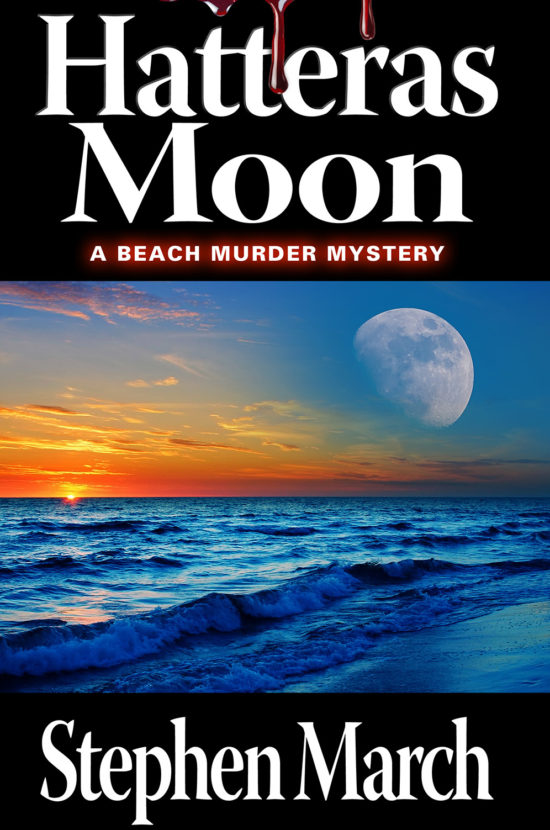
Hatteras Moon
| Buy this title now from these booksellers or a store near you. |
||||
| Amazon | Barnes & Noble | Books a Million | Powell’s Books | Indie Bound |

WHEN VIRGIL GIBSON signs on as crewman for The Dixie Arrow, an Outer Banks-based fishing trawler owned by his friend, “Hurricane Jack” Delaney, he is seeking a respite from his failed marriage and his mundane life as a college professor. He has no idea of the world of danger and death that awaits him. While fishing off the Carolina Coast, Jack and his crew are brutally murdered by a group of men masquerading as fishermen aboard another trawler. Virgil survives by hiding in a fish bin beneath a pile of shrimp and ice. He later flees the ship and spends a terrified night at sea clinging to a hatch cover and surrounded by sharks before he reaches shore on Hatteras Island. As a surviving witness, he knows he must not reveal his presence aboard the Dixie Arrow, which is officially listed as “missing at sea.” Haunted by the deaths of Jack and the crew, Virgil is determined to find their killers and bring them to justice. His quest draws him into the shadowy world of a dangerous adversary–a multi-millionaire with connections to rogue elements of the federal government. Virgil’s efforts are confounded by his growing romantic relationship with Nicole Andrisson, the millionaire’s beautiful and seductive mistress, whom he suspects of having betrayed Jack. Virgil’s odyssey forces him to search deep within himself–for the adventuresome, risk-taking spirit displayed by his boyhood friend, Hurricane Jack Delaney. His own courage and daring are the only cards he has left if he is to survive.
Hatteras Moon offers a unique blend of adventure, suspense, romance, and international political intrigue. It launches in April of 2013 as part of the Beach Murder Mysteries collection.
Pub Date: 04/01/2013
Price: $14.95 USD / $15.95 CAD
EAN: 978-1-938467-28-8
Trim: 5×8
Format: Trade Paper
Pages: 200
About the Author
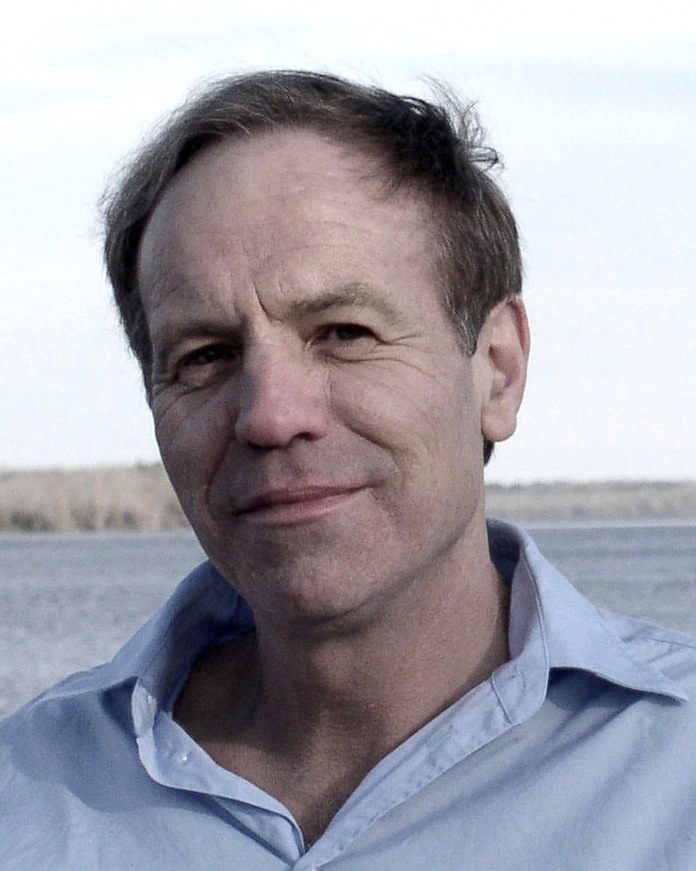
A former reporter for The Outer Banks Current, Stephen March is a professor of English at Elizabeth City State University. His published books include the novels Armadillo, Catbird, Strangers in the Land of Egypt, and Love to the Spirits, a collection of stories. Armadillo won the Texas Review Press Prize in the Novella and Love to the Spirits won the Independent Publisher Prize for Short Fiction. March’s short stories have appeared in New Orleans Review, Tampa Review, The Texas Review, Carolina Quarterly, the William and Mary Review, Seattle Review, Rio Grande Review, and South Carolina Review, among others. He is a graduate of UNC-Chapel Hill and UNC-Greensboro.
____________________
Excerpt
Prologue
On a hot summer night in 1972, Virgil Gibson was returning to Hatteras Island with four members of his football team–Leon McRae, Sam and Billy Coultrane, and Jack Delaney. Jack was driving his father’s ’49 Nash. They had gone to a dance at the old Casino in Nags Head. Jack stopped the car on the middle of the bridge over Oregon Inlet and said he was going to jump off. They all got out, laughing, half-drunk, none of them believing he was really going to do it. Jack took off his shoes and shirt and climbed up on the railing, facing the sea. The water was phosphorescent in the moonlight, the mouth of the inlet full of whitecaps.
Raising his arms, Jack stood there a moment, as if he were calling down some mysterious power from the sky.
“Get down from there, you dumb ass!” Virgil cried. The wind threw his voice back in his face.
“He ain’t going to jump,” Leon said.
Jack turned to smile at them, and then he stepped off the railing, disappearing over the side. Virgil leaned over the railing, looking for him. The wind sounded like a waterfall.
It was seventy-six feet down to the water.
“Jesus Christ,” Billy Coultrane cried. “Jack’s done killed himself!”
Virgil thought this might be true, but then he saw Jack floating on his back. “Jack, Jack!”
“He can’t hear you,” Sam said.
“Crazy damn fool!” Taking off his shirt and shoes, Virgil climbed up on the railing.
“I’m going in after him.”
He stood there a few seconds, looking down. He was thinking about the twenty dollars he had borrowed last Friday from his father and that he and his mother hadn’t been on speaking terms since the past Wednesday, when he had stayed out until three a.m. playing poker with Jack, Sam and Billy. It occurred to him if he drowned he would leave the world estranged from his mother and owing his father money.
“Get down from there, Virgil,” Sam called.
Virgil shut his eyes and stepped off the railing.
He fell very fast, the wind roaring in his ears, and when he hit the icy water he kept going down until his feet touched the sandy bottom. His chest and left arm felt like they had been hit with a baseball bat. Using his legs and his right arm, he swam straight up. When he reached the surface he was surprised by the power of the current. There was no way he could swim against it. He floated on his back, looking up at the arc of the bridge. In the sky the full, burning moon was encircled by a milk-white haze.
One by one he watched the others jump in, too.
Jack, Sam and Leon swam to shore. The Coast Guard fished Virgil and Billy out of the mouth of the inlet just before dawn. The wind had flipped Billy’s feet out from under him so he hit the water on his side, breaking his back and bruising his pancreas. Like Virgil he had survived by floating.
Virgil had three cracked ribs and a broken left forearm.
When the Coast Guardsmen got him out of the water, the first thing Virgil asked was, “Is Jack Delaney all right?”
I
Jack Delaney was in his black Corvette on the bypass getting ready to turn into the visitor’s center when he noticed a wasp on his dashboard–moving its antennae up and down in a slow, pendulous rhythm. Until he had seen the wasp his mind had been on Herrara, whom he was to meet at one p.m. on the airstrip behind the Wright Brothers Memorial. He was uneasy about the meeting, and the wasp’s sudden appearance was unnerving–a visitor with bad timing: he was allergic to its venom. He downshifted, and then turned onto the driveway. The noon sun made everything stand out with eerie clarity: the granite obelisk on the hill, the concrete visitor’s center, the metallic cars in the parking lot, the glass booth at the entrance. Driving slowly and keeping an eye on the wasp, he pulled into the parking lot at the end of the driveway. He decided to hit the thing with his wallet, but before he could get it out of his pocket, the wasp performed a nervous dance with its back legs, aiming its antennae at him. He got out of the car fast, the wasp shooting by his ear. Under the circumstances, he considered it to be a possible sign of bad luck.
He looked at his watch. It was 12:42. He got back into the Corvette and transferred his snub-nosed .38 special from the glove compartment to his pocket. Picking up the backpack from the floor, he locked the car, slipped on the backpack and started across the grassy field that lay between the visitor’s center and the monument. The runway was west of the monument, behind a row of trees at the end of the field.
He was sweating, and he had a throbbing pain behind his eyes.
At the end of the field he started up the walkway that wound around the ninety-foot hill. He could feel the breeze off the sea. When he reached the top he sat on the steps leading up to the monument. To the east the sea was a slice of hard bright blue, sandwiched between the line of cottages and motels and the lighter blue of the sky. The wind was out of the southeast, so he knew Herrara’s pilot would fly in over the Kitty Hawk Bay in order to land into the wind. He watched a Piper Cub rise above the trees and head into the clouds. Most of the planes that used the airstrip were for tourists taking air tours of the Outer Banks.
A woman and a boy were walking around the monument, the woman reading aloud the words inscribed on its base: “In commemoration of the conquest of the air–” Jack knew the words by heart–”by the brothers Wilbur and Orville Wright, conceived by genius, achieved by dauntless resolution and unconquerable faith.”
He heard Herrara’s plane before he saw it. He stood up and went down the hill toward the airstrip, remembering how he used to come up there to skateboard with Sam and Billy Coltrane back in high school.
The plane came in low over the bay and dipped below the trees. As Jack approached the end of the runway he saw Herrara’s twin-engine King Air taxi to the end and pull off into a parking area. Jack opened the gate and walked over to the plane. Two men got out, both wearing sunglasses. One was Rafael, Herrara’s chief body guard. Jack didn’t know the other man.
“Hey, Rafael,” Jack said. “How you been?”
“Reflux is giving me hell.”
“They got medicines for that.”
“Yeah, shit don’t work that good if you ask me. Raise your arms, I got to search you.”
“What the hell for?”
“New policy, man.”
Rafael patted him down, taking his .38. While Herrara’s other bodyguard examined the backpack, another man stepped out of the plane and stretched. Jack guessed he was the pilot.
“He’s waiting for you,” Rafael said.
Jack went up the steps and into the plane, wondering why they had searched him and taken his gun. He could feel a pulse beating in his temple.
Herrara was on a couch in the rear compartment, along with a Latina girl in a mini skirt. A solidly-built man with wavy black hair, he had on a white shirt, open at the collar. Jack could see the top section of the gold cross he wore on a chain around his neck.
“Jack, you look at this island from the air, it’s just a little ribbon of sand out in the ocean. Big storm would blow everything into the sound.”
“It’s worth the risk just to live here.” Jack said. He sat in a chair across from the couch, holding the backpack on his lap.
“You can drown in your bathtub, choke on a piece of steak.” Herrara looked out the window. “So this is where aviation got started, huh?”
“That’s right.”
“The monument mark the spot where the Wright boys took off?”
“They launched their plane in the field below.”
“How long were they in the air?”
“Not long. Less than a minute.”
“Most desirable things don’t last long.” Herrara smiled at the girl, who looked to be about sixteen. She was working on a wad of gum. “This is Marta. She wants to be an American citizen.” To the girl he said, “Qiueres ser una ciudadana de los Estados Unidos?”
She nodded, smiling. “Si, si.” She had bad teeth.
“All the poor people on the planet want to come to America. In Miami, we got thirty-nine different flavors of ice cream, twenty-four-hour TV, drive-through funerals, replacement parts for your body, plastic surgery to make you beautiful. This is the land of unlimited possibilities, the place where dreams come true.”
“I got your money.”
“Dump it on the floor.”
He dumped the money out on the floor of the plane, twenty bundles of hundred dollar bills, three hundred and fifty thousand dollars. The girl’s eyed widened. She had stopped working on the gum.
“Give the backpack to Rafael.”
Rafael took the backpack and handed it to the other man, who took it off the plane.
“What’s got you spooked, Lupe?” Jack asked. “They already checked that out.”
“This business requires a man to be careful.”
“You never been this careful before.”
“Business is getting competitive, amigo. Used to be plenty of room for everyone. Now people are fighting over the same territory.”
“I’m just a fisherman.”
“I’m your fairy godmother, too.” Herrara nodded at the money. “How much is there?”
“Half of what I owe you, like I said on the phone.”
“When will you have the rest?”
“To be honest, I’m not sure.”
“You’re way up in the air, Jack. Dancing on a wire.”
“You know how much I lost when my trawler went down?”
“Not my problem.”
“I always pay my debts. I’ll get the rest to you as soon as I can.”
“Hey, Rafael, hear what Jack said? He’ll pay me as soon as he can. Some joke, huh?”
“You shouldn’t worry so much,” Jack said. “Haven’t I always paid you?”
“You should worry more. Worry about your health. Thirty days. I don’t get the money by then, I’m going to be upset. That will bring much misfortune and suffering. You don’t want that. Believe me.”
Jack smiled at the girl. “Good luck.”
“Have a nice day,” she said slowly, flashing her decaying teeth.
“I got business to take care of,” Herrara said, scowling.
“I’ll be in touch.”
“Thirty days, Jack No bullshit.”
Rafael followed Jack off the plane. Once they were outside, Rafael returned the backpack and his .38–unloaded. “Hasta manana, fisherman Jack.”
Jack slipped the empty revolver into his pocket and walked back across the field toward the visitors’ center, carrying the empty backpack. Every step he took made his head throb. He watched Herrara’s plane rise above the trees and ascend into the clouds. He had always gotten along fine with Herrara, but then he had always paid on time, too.
Driving out of the park, he stopped by the booth at the entrance. The Park Service collected the entrance fee as visitors left in order to prevent traffic from backing up on the highway. A young woman in a brown uniform sat in the booth.
“One dollar, please.”
He looked through his pockets but he didn’t have any change. His wallet was empty, too. “Don’t seem to have any money with me,” he said, embarrassed.
“Hard to hold on to money these days.” She smiled and waved him on through. “Catch you next time.”
He drove south along the beach road, past all the motels and hotels, remembering how ten years earlier he could drive for miles on the beach road in winter and not see a soul, not even a light on in the cottages. Even during the tourist season a man had some breathing room, and the beaches were clean after the tourists left. Now new cottages, motels and restaurants were going up, the county averaged sixty thousand tourists on any day in August, and the beaches were littered with their trash—aluminum cans, cigarette butts, fast food wrappers. Houses were getting too expensive for an ordinary working person to buy.
He drove to Whalebone Junction and on down Highway 12 toward Hatteras, thinking about the snow geese that winter on the Outer Banks. He liked to see them in the sky and marshes and to hear them honking. They would be leaving for their northern breeding grounds soon, but they would return in the fall. The snow geese always came back.
He drove across the bridge spanning Oregon Inlet and into Cape Hatteras National Seashore. Then he began looking out the window for the snow geese. He had made some mistakes and had a run of bad luck, but that was life. You get knocked down, you pick yourself up and go on. First thing he had to do was finish paying Herrara off. That would be hard to do with his trawler gone, but he would find a way. After that he would need to buy another boat. No use in trying to get a job with a suit and tie. The sea was where he belonged, just like the snow geese belonged to the sky and the marshes.
As he drove south toward Hatteras he kept looking for the snow geese. That took his mind off the image of Herrara’s King Air disappearing into the clouds with his threats and a third of a million dollars–half of the money Jack still owed him.