
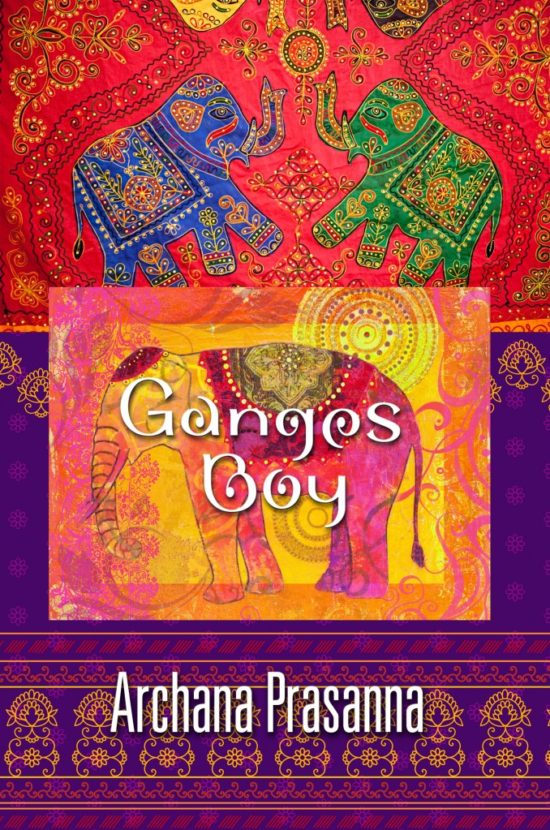
Ganges Boy
| Buy this title now from these booksellers or a store near you. |
||||
| Amazon | Barnes & Noble | Books a Million | Powell’s Books | Indie Bound |
Archana Prasanna’s Ganges Boy is a profound coming of age tale, set against the backdrop of the fascinating city of Varanasi, India. Kabir is an orphaned adolescent slumdog struggling to cope with the loss of his murdered mother. He tries to navigate the harsh reality of street life before getting submerged in a foreign world of luxury where he is forced to discover his own self-identity. The riches of his new life are overshadowed by the greed and immoral behavior he witnesses. This is the story of good and evil, riches and poverty, and the fight of a boy to keep his ideals no matter where he is. Kabir’s journey is emotionally engaging as his colorful experiences give insight into the lives of street children in Varanasi.
About the Author
Archana Prasanna is a Washington, DC native, but has experienced living in England and India. Growing up around the world has been a source of inspiration for her writing. Archana has an undergraduate degree in Political Science from Virginia Tech and a J.D. from Syracuse University. She began writing news articles that appeared in The Washington Post, pr.com, and The Collegiate Times. Ganges Boy is her first novel.
Excerpt
Chapter One
Village Life
Lord Siva, the best of demigods, who carries on his forehead the emblem of the moon, receives on his head with great devotion the Ganges water emanating from the toe of Vishnu. ~
Niraj was a shy, awkward lad with shaggy hair and patched clothing that never quite fit. He assisted his mother, Sanskriti, as she worked at her loom in the sari factory that sat at the edge of his village located just south of the great city Varanasi and close to the River Ganges. The villagers were easily characterized: impoverished and always hungry. It was the same for all of them. It had been the same for generations. They were the poorest of India’s poor. Niraj had learned his place – wherever nobody else might want to be.
Like boys will do, Niraj often escaped from the mundane tasks of his life through wonder-filled daydreams in which he stared – bravely diving into the waters of the river Ganga from a great height, or racing with long, perfect strides along the tops of the ghats, receiving looks of admiration from all he passed.
His mother would gently bring him back to the important tasks at hand.
“Watch what you’re doing! Keep the weft threads taut, or those rows will be crooked and Mr. Malik will be unhappy with us.”
“Yes, Ma,” he groaned impatiently though never really disrespectfully.
He still managed guarded glances across the rows of looms in the big room and out the small, grimy, windows in search of some pleasant diversion or promise of fun awaiting him outside once his day was finished.
Ten minutes earlier, his good friend, Kabir, had flashed him a sign from across the room. They could get together, later. For the time being, Niraj focused on the beater, and battened the weave his mother had just finished. She had completed the border of the shawl she was working on and began the intricate design, which would render it in the popular Benares pattern. Of all the weavers she was one of the best.
Sanskriti was a pleasant looking woman. Her long, agile, slender hands were perfect for creating delicate patterns with the fine, hand-died, colorful thread. She worked long hours but despite the grueling work, her fair face always remained gentle and her eyes danced brightly. They were accentuated and enhanced by her modest use of black eyeliner when she could afford it. She spoke softly, and frequently cast smiles in her son’s direction as if telling him their workday would soon come to an end. Niraj would usually acknowledge her with a nod or by returning the smile – imperceptible to many but never to a mother.
Niraj had been assisting his mother at the factory for most of his life – almost as long as she had worked there. Even so, she rarely allowed him to do any of the actual weaving or sewing. He was relegated to tasks such as carrying spools of yarn, and battening the weft threads in the loom. He had other duties at the factory, as well. Along with his best friend, Kabir, he spent some time every day dying the wool yarn and keeping the factory workstations supplied. The two of them looked for any opportunity to sneak into the vat rooms in the back near a pond where they could dump the unusable, diluted dyes, and mix new combinations of color. It became more than a pleasant diversion – it regularly brought out the imp in each of them – that imp, which universally resides somewhere deep inside every ten year old boy.
While working on the beater, Niraj smiled to himself. His colorfully stained hands reminded him how Kabir had dropped a stone into the mixture they were playfully brewing in the pond several days before, splashing him with indigo dye. They took delight in catching the other off guard and creating indelible splash marks on one another’s clothing and skin. The very best, however, was a face stain – one ample enough to remain for a week or longer. That they considered the ultimate score on the other. Over the course of the time they had been working together they had become so alert to that possibility that it rarely occurred – all the better when it did, of course!
They had to be careful so it didn’t appear they were messing around or wasting dye because Mr. Malik, the factory manager, would strike them or dock Niraj’s mother’s pay if he suspected mischief. In cases of their more egregious infractions, Sanskriti would receive a slap as well, which was something the boys never wanted to risk.
Mr. Malik was a fat old man, generally disgusting in appearance, who had frown lines etched deeply onto his forehead, disclosing his typical state of mind. His great size caused him to be perennially out of breath. Beads of sweat dripped from his face – his brow, his nose, even his ear lobes. He was an inconsiderate sort and quick of temper. He had but one goal, to see that his workers spent every moment pursuing their tasks – perfectly.
Niraj glanced in his mother’s direction and relived a flash of remorse from an incident that happened several months earlier. Mr. Malik had mistakenly thought Niraj had broken a wooden shuttle that he discovered lying on a table near the door to the vat room. As was typical of the man and before really looking into the matter, he confronted Sanskriti and administered a series of stinging blows as punishment for her son’s alleged carelessness.
Within moments the manager of the loom room corrected Mr. Malik, disclosing that he was the one who had placed the shuttle there for repairs. It had broken through routine use as they often did. Mr. Malik would not apologize to Sanskriti or admit his error, of course. Things of kindness found no place in his approach to living.
The heartbreaking memory passed and Niraj again turned his attention to the windows hoping to see Kabir waiting outside.
“Ma,” he whispered, “It will soon be the time, may I go to play first?”
She paused for a moment and looked into his beautiful, dark, eyes. They pleaded for a break. Although she was as lenient as any mother in the factory, she was reluctant to allow him to go off with Kabir, his Muslim friend, during the call to prayer. She broke a faint smile and returned to her work without a word. He understood it was her way of permitting him to leave without either approving of it or speaking it aloud.
Niraj quickly made his way across the factory floor, weaving his way among the other looms. He smiled at the women and children as he passed but didn’t take time to stop and chat. They understood that a boy his age had to make the most of whatever time he got for himself. Mr. Malik watched through the ever-soiled glass window of his ever-cluttered office near the front of the building. His glistening brow furrowed as he watched the lad exit through the open sliding door that led to the loading dock. He clearly wished he had some reason to keep the boy at work.
Outside, Niraj paused for a moment to inhale deeply, clearing his lungs of the continually polluted air inside the building. He had been breathing the chemical fumes from the factory since birth, but had never become used to them. All day long, every day of his life his young lungs struggled. He greeted the fresh air with a smile and almost immediately found renewed energy building within his being.
As he looked toward the docks hoping to locate Kabir, he caught sight of his friend’s tunic as it disappeared behind the factory. He ran toward the river and searched for him among the crates and pallets. Kabir was on the dock at the river. They spotted each other at the same moment and met at the dumping station. Before they could agree on how to spend the small amount of time they had, the call to prayer split the air bringing their plans to a screeching halt.
Niraj and his mother were, more or less, Hindu but lived in a Muslim neighborhood. She had settled there before he was born, and it had become home. Despite Niraj’s love for the village, he often felt isolated because of the ridicule from other children. They taunted him for his looks and for wearing stained, patched, clothing. Truly, he was never fully accepted into the community. His father had practiced Islam and his mother Hinduism. Niraj, having been born out of wedlock was seen as nothing more than a bastard child unworthy of respect or of worshiping any god.
“Alla-a-a-ahu Akbar. Ash-had anna lah, ilaha illallah . . .” a voice wailed through the village, crackling over an aging public address system from the mosque. The two boys instinctively turned their heads toward its source. Kabir, Niraj’s best and only friend smiled and began walking. Niraj matched his quickening pace. Mr. Malik exited the factory to make his way to salat as well. He watched them ahead of him, laughing and talking back and forth as they broke into a trot. He shook his head in disgust knowing that Niraj would again be present at the holy masjid.
After arriving at the mosque, Kabir found a spare mat leaning against an ancient, stone, wall. The boys entered the open-air prayer hall through the archway and navigated through the small sea of prostrated men. Kabir found an area in the courtyard free from stones fallen from the crumbling walls and unfurled his mat so he would be facing the mihrab where the imam was already leading the prayer. He hurried to prostrate himself and took up the chant with the others.
Brushing aside pebbles and other debris, Niraj made a seat on one of the larger fallen stones and watched the imam respectfully. He tried to ignore the sneers from several children but his face went red with embarrassment and he forced himself to hold back tears. Even this place of worship was not free from the taunts that seemed to await him everywhere there in the only World he had ever known.
Mr. Malik rolled out his sajada, a portable work of art, plush and ornate. It was one of the finest in the region. As he knelt, his eyes met those of Mullah Najid, who had looked up momentarily as he saw the boys arrive. The Mullah’s glare telegraphed culpability and Malik tensed at the thought of unofficial reprisals. He shook his head, and positioned his palms upward as if to communicate his own disapproval of Niraj’s presence and his powerlessness to keep the Mosque undefiled, even though the boy worked at his factory. It was, he believed, a problem under the prevue of the Mosque officials, and he certainly had no authority to say who could enter its confines to praise Allah. The Mullah lowered his head and continued his prayer.
Niraj sat quietly on his chalky stone perch, watching the imam as he prayed. He fiddled with a Shiva lingam in his pocket trying to make sure know one discovered he had brought a Hindu deity into a Muslim mosque. He inadvertently kicked one of the rolled mats causing it to fall against a lady who was walking by.
“What a strange boy,” the lady remarked in disapproval as she moved on.
Though such remarks were not unfamiliar to him it still seemed odd that his slightest indiscriminate act should attract such notice and ridicule. One of his life’s lessons had been that acts of prejudice need little – often, no – provocation. He thought it was disturbing that the last remark out of a person’s mouth before prayer would be one of contempt. It prompted questions about religion and relationships.
He surveyed the courtyard, stopping to look at what was left of the now fallen but once grand minaret. He imagined that it had originally risen to a height of ten meters (thirty plus feet). It was difficult to tell. Most things in and around his village, including the courtyard, had looked the same his entire life. He had passed by it often with his father, who had explained that old traditions needed to be preserved. It was the main reason Niraj liked going there with Kabir for the midday prayer – the comfort of tradition. His father had never taken him, but promised that he would when he came of age. With his father’s death the previous year, that dream had died as well.
It had all begun months before when Niraj followed Kabir to prayer one day. It seemed somehow comfortable and he decided to keep going. He felt a kinship to these people, through his father, even though he had never been included in any rites or ceremonies. It was not really until his father’s death that he had developed an interest in the religion, and then mostly because he missed his father so much. Sanskriti was uneasy about his attendance at prayers, but understood his growing interest and the comfort it gave him.
Within ten minutes the prayer had ended and Kabir stood, re-rolled the mat and replaced it against the wall. The boys walked back through the arched gate. Kabir suggested that they go back to the dock until compelled to return to work. Niraj readily agreed.
“Niraj!” a strong, deep, voice called from behind the two of them.
They swung around to face the heavy breathing Mr. Malik. Sweat poured down his neck disappearing into thick clumps of matted hair protruding from his undershirt. He was in every way a disgusting human being.
“Yes,” Niraj replied.
“Boy, there is a small crate at the railroad station. I want you to take the pull cart and fetch it. Hurry now.”
Mr. Malik clearly believed the boy’s life was his to command.
The two boys’ eyes met in momentary sadness. So much for fun on the dock. That would have to wait for another time. They trotted on ahead so they could curse Mr. Malik out of his hearing. They kept their pace for the three blocks to the rear of the factory.
Niraj found the pull cart just inside the rear door. The trip to the station was short and he had soon returned. He pulled the heavy cart to the front of the building, and then went inside to report his arrival to Mr. Malik, who was walking the loom room complaining to each woman about her work as he passed. He told Niraj to get Kabir to help him unload the crate at the back door.
Niraj walked toward the office where he thought he might find Kabir. On the way he saw his mother working at her station and thought he should see if she needed any assistance seeing that he had been gone for so long. He walked to her loom and plopped down beside her, causing her to jump and gasp.
He hadn’t intended to startle her, so moved close to comfort her. He was surprised and saddened to see that her eyes were swollen and red. His first thought was that she had been hurt and he became immediately defensive.
“What is the matter?” he asked. “Has someone hurt you?”
His mother had seemed on edged for several weeks. She recovered her composure quickly.
“No, you startled me is all,” and she turned her face away and went back to her work.
Niraj was not satisfied with her response and asked again, “What is wrong, Mother? You look as though you’ve been crying.”
“Don’t worry, I am well,” she replied.
She managed a faint smile in his direction. It was another signal, which he understood well. He was not to press her further about the reasons for her tears. He had seen her cry often, especially during the past year since his father’s death. He understood that her life had been difficult, although he knew only the sparest reasons for it. There were many mysteries that filled his mother’s life and he was expected to just accept and leave it at that. In this case, he would never know what cruelty had been spoken or what indignity she had suffered during his absence. He put his hand gently on her shoulder as he explained that he would be gone for a short while longer to unload the cart in the back. He hesitated as if to add something but then left without saying it.


very well written, easy flowing and nice piece of writing please – congratulations galore, Archana.
however, i think i noticed two editorial mistakes in this short excerpt itself – one stays in memory where ‘know’ has been put in place of ‘no’.
and i only hope that part of the Azaan that is quoted in-here is accurate. it will be good to rechcek these if at all possible at this stage.
Best of lucks with your first book… Will read every line and let you know.
Viswa
Hi Archanna
I like it. Where can I read more?
Regards,
Vijay Kulkarni
Archana, just the above paragraphs have excited my curiociry. I cannot wait to read the whole book. I am very happy for you, Kala and Prasanna. I still remember coming to your party on Dufief Dr. Wishing you the very best.
Sheela Kadambi
Will there be a formal launch event of the book?
Thank you
Srini Prasanna
The book is already out. Why does the website say “launches in March 2013?
Pingback: Scheduling Tour for Ganges Boy | Enchanted Book Promotions | Book Publicity, Marketing and Virtual Book Tours
Pingback: Book Review Ganges Boy by Archana Prasanna | Forever Book Lover
Pingback: Book Review: Ganges Boy | Bookaholic Ramblings